Stage 0 · unpaid independent researcher · approximately $200 compute
Training changed the flock. It did not teach the principle.
Three Stage 0 experiments establish a narrower, more useful result: the pipeline changes collective behavior, but neither direct training nor cross-game transfer discovered a viable strategy. These are inspectable diagnostic traces—not effect sizes.
Experiment 1 · source game
Training delayed collapse. Nothing survived.
The Commons Game is the gen 0 training environment—different rules from Shared Resource, with no single closed-form optimal policy. The run uses logistic regrowth rate r = 0.75 over 200 rounds.
Commons Harvest pilot, three seeded fractions
Stock by round, one seed per condition. Every arm eventually collapses; the seeded fraction changes how long that takes.
One seed per condition No replication and no interval. Full seeding delays collapse to round 170; no arm sustains the commons, the artifacts are not frozen, and no effect is claimed.
What changes between the training source and the answer key?
The games have different jobs. The Commons Game asks whether training moves a difficult trajectory; Shared Resource asks whether it learned a viable principle or only a source-game habit.
Source game
Commons Game
Agent action
Request a harvest from 0–10 each round while paying upkeep.
Resource
Shared stock with logistic regrowth: g(S) = rS(1 − S/K).
What is known
Peak sustainable yield is rK/4; simultaneous bids leave no single optimal policy.
Stage 0 role
Training source. Full seeding moved collapse from round 33 to 170; every arm died.
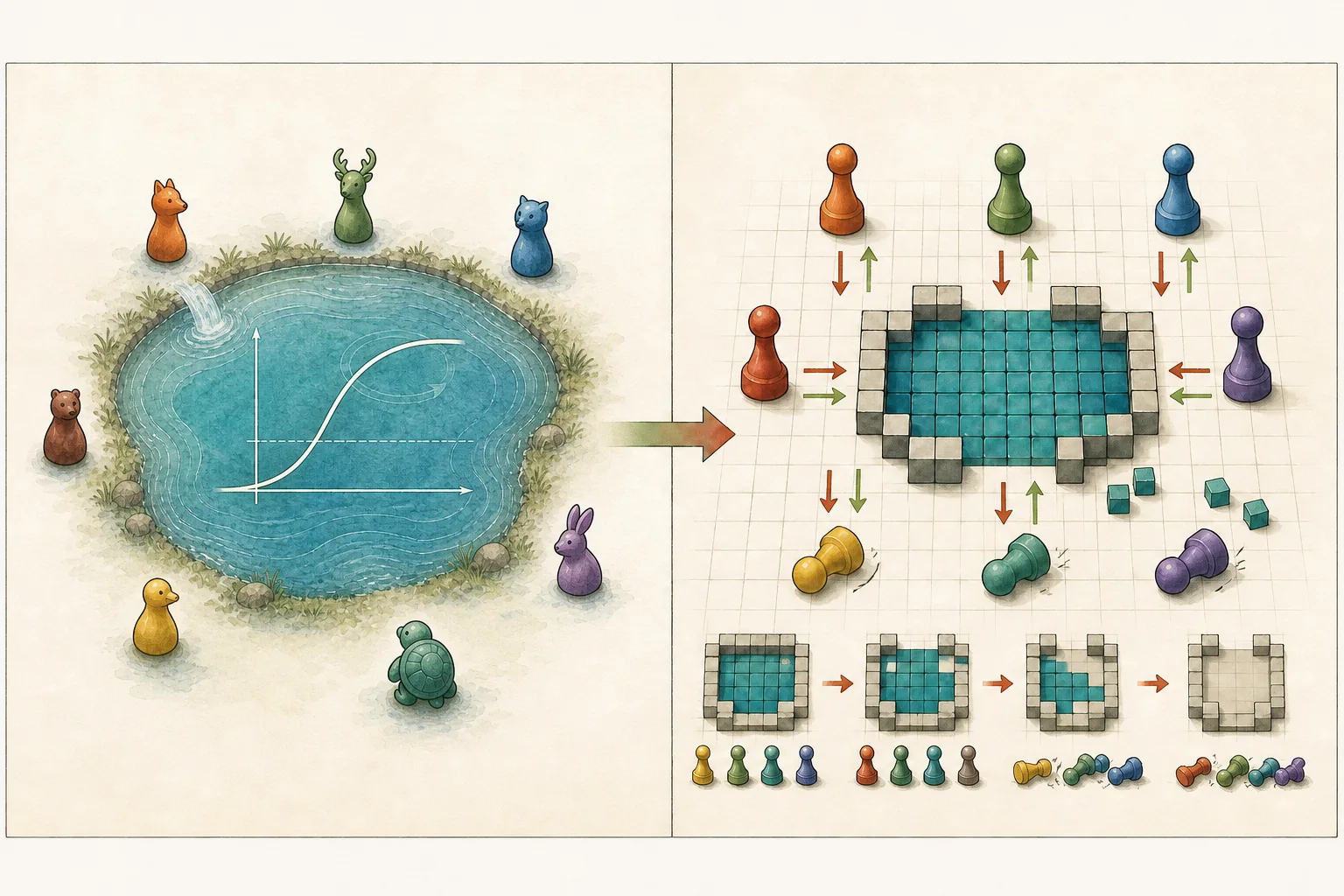
Two visual grammars. The Commons Game is smooth and self-regenerating. Shared Resource is countable and discrete: simple actions move exact tokens until the pool—or the flock—is ruined.
Why the second game matters
Restraint is not coordination. “Take less” became rigid self-sacrifice where flourishing required give-and-take. The target game makes that distinction arithmetic.
Selective scale check
Repeat the informative comparison on at least one 70B+ open-weight model. Stage 0 used Qwen2.5–7B to fit one GPU. After calibration, a focused replication can test whether lockstep over-restoration is a small-model limitation or survives scale. This is one validation arm, not a full 70B sweep.
Direct-training result
Experiments 2–3 · one target game · two training routes
Neither route found the strategy.
One Qwen2.5–7B policy was trained for 2,000 PDD steps on Shared Resource itself. Another was trained in the Commons Game, then moved here without further fine-tuning. The answer key is simple: restore on half the turns and take on the other half.
Compare an untrained population with directly trained and transfer-trained populations
Untrained controlOne bot breaks rank
pool
Shared-trainedDirect training
pool
Commons Game–trainedCross-game transfer
pool
Inspect this turn in both uploaded JSON files
Direct run · untrained control
Direct run · Shared-trained
Transfer run · untrained control
Transfer run · Commons Game–trained
Same target-game failure after two training routes. Both trained populations restored on 100% of actions and died on turn 6; both untrained controls restored on 98% and died on turn 8. Direct training did not solve the target game. Opposite signs across source and target: the Commons Game adapter bought +137 rounds where it trained, then cost 2 turns here. These traces reject two recipes; they do not settle PDD or post-training generally. One trace per condition · no effect size · receipts not yet committed
The open research question
How can agents discover prosocial strategies—not merely cooperative-looking actions?
Here, flourishing means keeping both the agents and the resource alive. More restoration is not automatically better. The next step is to train inexpensive populations across many known-answer test fixtures and ask whether they discover viable strategies automatically, then retain them when the rules, partners, or game change. Flockbench is the laboratory for finding where that works, reverses, or collapses.
Receipts and caveats, at the bottom where they belong.
The claim ledger, campaign receipts, withdrawn claims, and calibration audit remain public in the historical record. Both target-game JSON traces are now checked in; the run receipts and provenance bundle are not yet committed.