One bot breaks rank and takes, delaying the population's collapse.
Stage 0 built independently · Tier 1 · $290,000
How can a partial coalition keep a commons alive when no one controls the whole population?
Flockbench studies this question through two deliberately different games: the smooth, self-regenerating Commons Game and the discrete Shared Resource answer key.
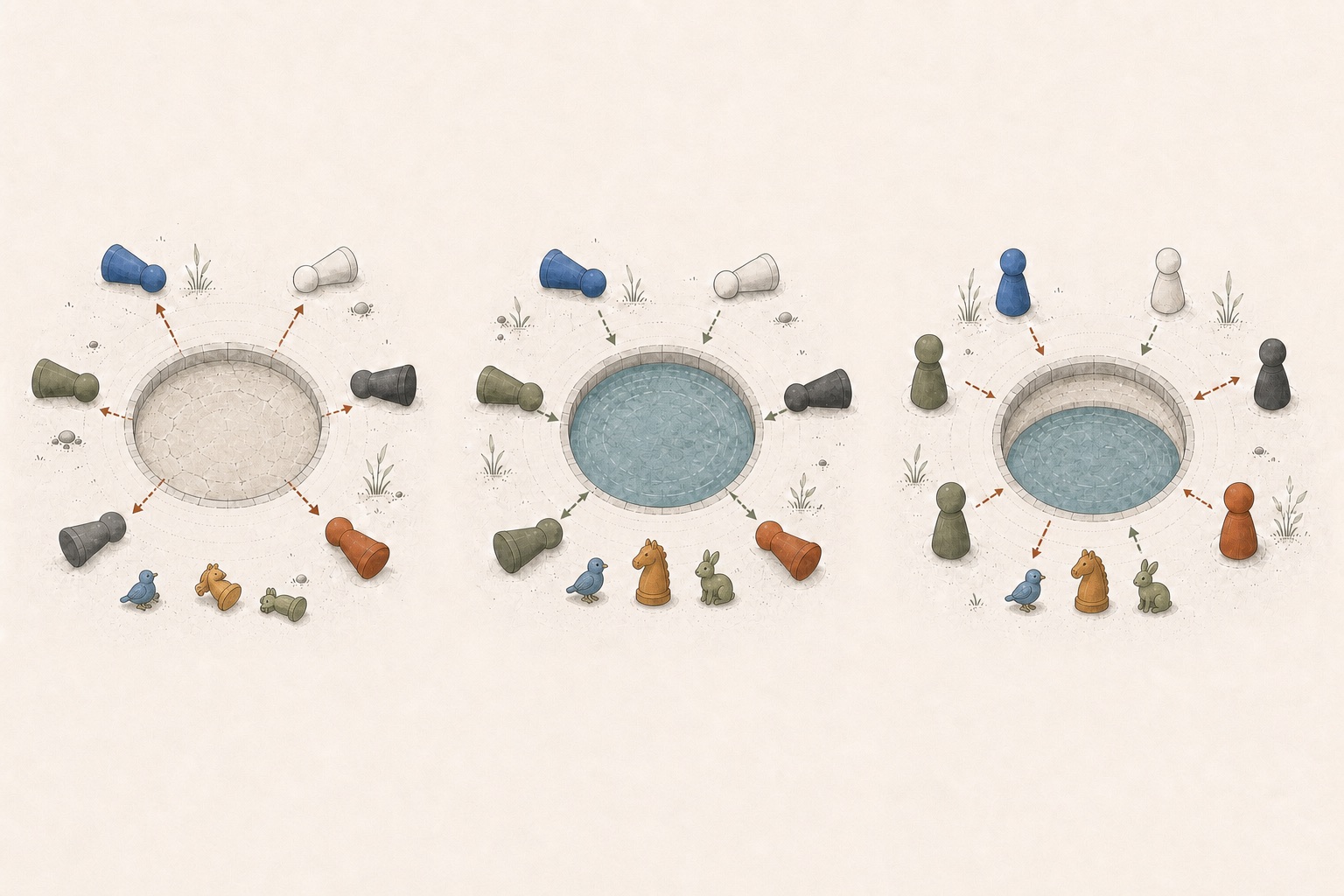
Shared Resource · live answer-key model
Move one control. Find the cliff.
Eight agents share a finite pool for 200 turns. Change how many seats you control and how the others behave. This is a theoretical answer key—not yet a result about language models.
survives · collapses. The outline marks the smallest fraction that holds. Change the majority rule and the threshold moves—that dependence is what the study measures.
Calculating…
Shared pool
≈ $200RunPod credits spent out of pocket in Stage 0
Qwen2.5–7Bsmall enough for single-GPU LoRA experiments
1 researcherindependent and unpaid during the prototype
No LLM judgesurvival and stock follow from the rules
Stage 0 finding · one seed per condition
Training changed the failure mode. Neither route solved the game.
In the source game, the adapter delayed collapse from round 33 to 170—but no arm survived. In Shared Resource, both direct training and cross-game transfer produced the same rigid failure.
In both uploaded traces, all eight restore together, spend themselves down, and fall at once.
What the pilot supports: both training routes changed behavior, but neither discovered the alternating strategy. These are diagnostic traces—not effect sizes—and the receipts are not yet committed.
Next
The pilot is the reason for the study, not its answer.
Stage 0 shows that training can change a population and that the result can reverse across games. It does not estimate an effect.
The study predeclares the decision rule, measures the controlled-fraction response, and tests when the surrounding majority propagates or defeats a minority strategy.